
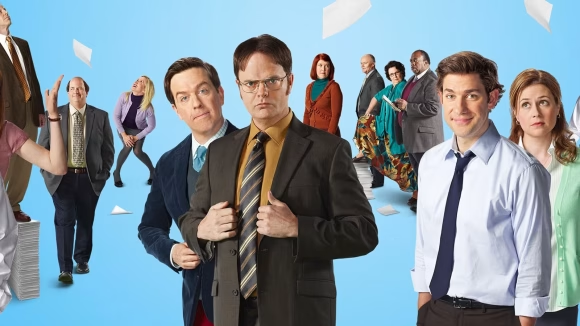
(Photo Courtesy of Collider)
This piece is from the CU Independent’s opinion section. Any opinions or views do not represent the CU Independent.
In today’s entertainment industry, nostalgia has become the ultimate business strategy. Instead of creating brand-new, original movies or TV shows, studios and streaming platforms are leaning into familiar titles with large built-in fanbases. These are the shows and films people watched after school, the movies they quoted with friends, and the characters who felt like part of their lives. Reboots, revivals, and remakes promise to bring that feeling of nostalgia back to the hearts of those who once, and still, love a particular story. But time and time again, these projects fall short of capturing the same magic as the original.
The simple fact is that the magic of an original movie or TV show can’t be replicated because it’s not just about the plot itself. Instead, it’s about the time the original came out, the cultural context and the personal memories tied to it. For example, when the TV show “The Office” aired in 2005, it was unlike anything seen on television before. “The Office” used a mockumentary style format, had deadpan humor and depicted relatable awkward workplace culture which hit a nerve for many people who were also navigating workplace struggles. It wasn’t just a comedy for everyone to enjoy; it was able to capture the spirit of office culture at a very specific moment in time.
The sequel to “The Office” that just came out, “The Paper,” premiered on Peacock in September 2025 and is also a mockumentary style TV show and follows a team of journalists trying to revive a struggling newspaper called The Truth Teller. Although this sequel has a whole new cast, it does have one familiar face from the original which is Oscar Martinez (Oscar Nuñez). “The Paper” has received good ratings and was picked up for another season.
However, even with strong early reception, “The Paper” faces a massive challenge that almost every reboot, revival or sequel encounters: it exists in the shadow of its predecessor. “The Office” wasn’t just a TV show; it was a cultural moment in time. “The Office” shaped the modern workplace comedy and influenced an entire generation of TV writing with a new mockumentary filmmaking style. With “The Paper,” the tone of the show, the pacing and the format all feel familiar, but that familiarity can be both a strength and a burden. Unlike “The Office,” which captured the early 2000s office culture, “The Paper” enters a completely new media landscape where much of the humor that worked two decades ago wouldn’t resonate, or even be acceptable, today.
The show cleverly tackles the challenges of print journalism in the digital age, but it doesn’t have the element of surprise that made “The Office” stand out. Fans can appreciate the new sequel, but it will never be able to fully compare to the original. Reboots and spinoffs can attempt to recreate our favorites, but they can’t always recreate the emotional bond fans had with original characters and the actors who played them. Viewers didn’t just watch Jim, Pam and Dwight, instead they grew up with them and watched their characters develop into the people they love. For many, “The Office” is tied to late-night binge sessions, shared quotes and a kind of comfort TV that defines a generation.
A similar idea can be applied to the movie “Mean Girls.” When the original film came out in 2004, it wasn’t just a teen comedy; it shaped how a generation understood high school cliques, social hierarchies and early digital gossip culture. I remember being in middle school, watching the movie and thinking, This is what high school must be like, and ultimately being very wrong. Even though I wouldn’t say that movie was much like my high school experience, or most other people’s, it defined the typical high school teen movie. Lines like “On Wednesdays we wear pink” became part of everyday language and can still be seen on shirts and tote bags.
The 2024 reboot, a musical, while somewhat entertaining, was not able to match the original impact “Mean Girls” once had. One of the biggest criticisms of the “Mean Girls” reboot was that it leaned way too heavily on old jokes and replicated iconic scenes without bringing enough new energy to the movie. It felt like the cast was just quoting the old movie, instead of having its own standalone story with aspects of the old movie. While I still enjoyed seeing the familiar characters and lines I grew up with, it didn’t make me feel the same way the original did. The reboot felt more like it was trying to remind me why I loved the original instead of giving me something completely new.
Reboots, spinoffs and sequels walk a super fine line: staying too faithful often makes it feel outdated and irrelevant, while overly modernizing can take away from what made it beloved. This tension is why so many nostalgic projects land awkwardly in the middle. They often struggle to find a balance between honoring the original’s legacy and appealing to a new generation who are living in a different world with different humor. Nostalgia can be powerful, but only when it’s used as a foundation for a story, not a crutch.
Shows like “The Office” and films like “Mean Girls,” along with many others, became cultural milestones because they were unexpected and original. Their characters, tone and style felt new and exciting. You can’t recapture that lightning in a bottle by copying it, you have to create something new. Originals resonate because they lead to cultural conversations, not because they follow them. They set trends, shaped humor and influenced how people talked about everyday life. When “The Office” came out, there wasn’t anything quite like it’s style and awkward humor. When “Mean Girls” premiered, it wasn’t just another teen high school movie, it became the teen movie of its generation.
Of course, not every reboot or revival is destined to fail and not capture the nostalgia of the original. There have been examples that do prove nostalgia doesn’t have to be a creative trap. A perfect example of this is “Freaky Friday.” The famous 2003 version was originally a remake of the 1976 film, and then another remake came out in August called “Freakier Friday.” “Freakier Friday” was able to reimagine the story from a new time period. The 2003 version was in a time where technology culture was rising but still very much so limited. The 2025 version, however, is set in a world where technology dominates and a new generation is learning to navigate it. The movie feels fresh and creative, introducing new characters and storylines while keeping familiar faces and references from the original.
The key difference between reboots that fail and ones that succeed are the successful ones don’t just replicate, they reinterpret. These examples show that recreating nostalgia isn’t a bad thing. When a reboot or spinoff evolves the story and respects its audiences, it can become a cultural moment in its own right.
Nostalgic reboots, revivals and spinoffs often fail because they chase something that can’t be recreated such as a moment in time, a cultural energy and a personal emotional connection. Projects like “The Paper” and the reboot of “Mean Girls” will always live in the shadows of the originals. But stories like “Freakier Friday” prove that when creators use nostalgia as a foundation, they can craft something that speaks to the present while still honoring the past. Nostalgia shouldn’t be about reliving the same exact magic in a different decade; it should be about creating new magic inspired by what came before.
Contact CU Independent Writer Emily Eigenbrode at emily.eigenbrode@colorado.edu
