
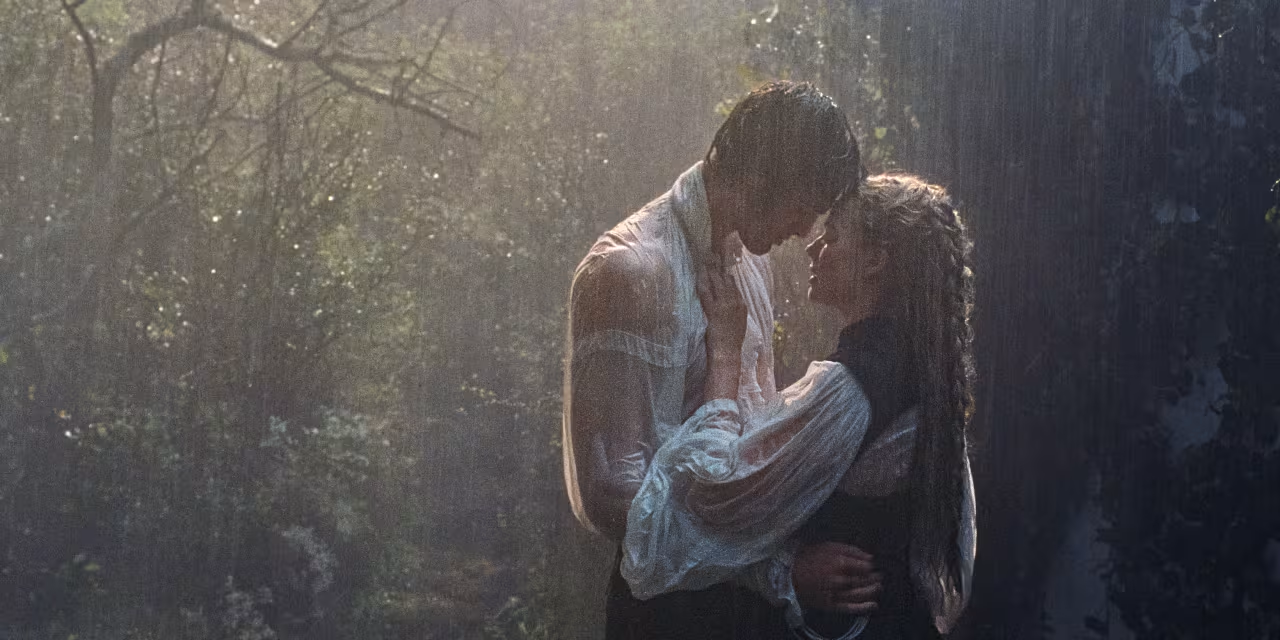
Jacob Elordi and Margot Robbie in ‘Wuthering Height’ (Image Courtesy of MarketWatch)
Alexia: Hi! I’m Alexia Bailey, a sophomore here at CU Boulder. While I may just be in my second year, I’m here to share everything I’ve picked up so far, which is a surprising amount of information. “What’s Eating at Alexia” is my unofficial and unfiltered guide to some of the things that being a CU Boulder Buff brings. Think of it as your guide to navigating everything that makes CU Boulder, well, CU Boulder. Whether you’re a freshman finding your footing or a senior with “no body, no crime” level grievances about finals week, I’m here to share my takes, tips and honest observations on everything from the sometimes-unpredictable Buff Bus system to navigating campus protests (or dodging them entirely). College is a wild, unforgettable ride, and “What’s eating at Alexia” is here to make sense of some of it, one opinion at a time.
The first time I watched “Superbad,” it was in my family’s makeshift living room, and honestly, I don’t think there could be any better place to watch the film. Surrounded by questionable green carpeting and 1970s citrus wood paneling, watching Christopher Mintz-Plasse turn himself from Fogell to McLovin felt like witnessing a rite of passage. It was awkward, chaotic and somehow endearing. But after rewatching it years later with my roommate, something else stuck out to me. While the boys stumbled through growing pains and got full personalities, the girls mostly felt like goals to be achieved or obstacles to overcome. They were funny, sure, and occasionally sharp, but rarely complex. Sure, “Superbad” (barely) passes the Bechdel test; however, the women existed around the story instead of inside it.
And that realization made me think about how often women in the media are asked to play supporting roles in narratives that center everyone else’s growth. The love interest, the prize, the emotional anchor, the lesson, but rarely the mess. Rarely, they play the person allowed to be loud, uncomfortable or unapologetically flawed without being punished for it.
Growing up, I didn’t always notice this. When a movie is funny, or nostalgic, or tied to a memory you love, it’s easy to overlook what’s missing. But once you start paying attention, it becomes hard not to see. The camera lingers longer on women’s bodies than on their personalities. Their mistakes are framed as cautionary tales instead of comedy. Their confidence is either mocked or softened so it feels acceptable.
And yet, when I say this, I have men throw movies like “Barbie,” “Little Women,” and “But I’m a Cheerleader” in my face as a counterpoint. As if a handful of female-led stories somehow balances decades of narratives where women were written as decoration instead of people. The existence of good representation doesn’t erase the history of bad representation. Those films stand out precisely because they feel different. They let women be angry, funny, complicated and human instead of existing only to propel someone else’s character arc. There is no focus on their boobs, none! And even then, it’s telling that these movies are often treated as niche, or “for women,” while stories centered on men are still considered universal. Nobody calls ‘Superbad’ a movie “for boys,” but films about women are constantly framed as belonging to a specific audience. The assumption lingers that men are the default viewers, and everyone else is a genre.
Of course, I can’t ignore that ‘Superbad’ came out in 2007. But lucky for my argument, “”Wuthering Heights”” hit theaters on Feb. 13. While the film has been described as a “fiercely feminine” reinterpretation, centering the intense, hyper-sexualized relationship between Cathy (Margot Robbie) and Heathcliff (Jacob Elordi), it still falls into the same trap. Even when the lens shifts and the marketing promises something bold and female-forward, the story can remain fixated on a woman’s desirability, her volatility and her body. The framing may change. The aesthetic may be glossier. But if a woman’s complexity is reduced to how deeply she loves, how destructively she wants or how beautifully she suffers, we haven’t really expanded the narrative; we’ve just updated the packaging. After all, it’s disappointing to see Margot Robbie’s fall from feminist grace after her multi-million dollar ‘Barbie’ success.
I hope that ‘Wuthering Heights’ is just a bump in the road on the way to stronger female representation in popular culture. I am truly hopeful about upcoming movies such as “Supergirl,” “The Bride!” and “The Devil Wears Prada 2,” stories that have the potential to let women be more than symbols of desire or vehicles for someone else’s growth. Because that’s really the point. This isn’t about canceling old movies or pretending I don’t laugh every time I watch “Superbad.” Nostalgia and critique can exist at the same time. But revisiting the film and Angelica Kalika’s Media and Diverse Populations course has taught me how easily we accept certain narratives as normal simply because they’re familiar.
The good news is that audiences are starting to ask for more. We’re learning to recognize when representation is genuine and when it’s just a new coat of paint. And maybe that means the next generation won’t have to stretch so hard to find themselves inside the story.
Maybe one day, you’ll even see yours truly on the big screen…or maybe not.
Contact CU Independent Opinion Editor Alexia Bailey at alexia.bailey@colorado.edu
